Material handling efficiency plays a critical role in modern manufacturing
industries such as food processing, pharmaceuticals, chemicals, plastics, and minerals. When
handling powders, granules, or bulk solids, industries often compare pneumatic conveying systems
with mechanical conveyors, especially screw conveyors.
While mechanical conveyors have been traditionally used, industries are
increasingly shifting toward pneumatic conveying due to its superior hygiene, flexibility,
safety, and long-term operational benefits.
This guide explains the advantages of pneumatic conveying over mechanical
conveyors, helping you understand which system is best suited for your plant.
Pneumatic Conveying vs Mechanical Conveyors - Quick Answer
A pneumatic conveying system uses air pressure or vacuum to move
materials through enclosed pipelines, offering dust-free, hygienic, and flexible material
transfer.
Mechanical conveyors, such as screw conveyors, rely on moving mechanical
parts and are typically limited to short distances, straight layouts, and higher maintenance
requirements.
This is why pneumatic conveying systems are preferred in industries handling
fine powders, abrasive materials, or hygienic products.
What Is a Pneumatic Conveying System?
A pneumatic conveying system transports powders or bulk solids through
pipelines using controlled airflow generated by blowers, compressors, or vacuum pumps. The
material remains enclosed throughout the conveying process, ensuring clean and safe handling.
Industries increasingly rely on an experienced pneumatic conveying system
manufacturer to design solutions based on material characteristics, conveying distance, plant
layout, and process requirements rather than using standard equipment.
There are two main types of pneumatic conveying:
- Dilute (Lean) Phase Conveying System – high velocity, low pressure
- Dense Phase Conveying System – low velocity, high pressure for gentle handling
What Are Mechanical Conveyors?
Mechanical conveyors move material using physical components such as belts,
screws, chains, or buckets. Common mechanical conveying systems include:
- Screw conveyors
- Belt conveyors
- Bucket elevators
- Chain conveyors
Among these, screw conveyors are widely used for short-distance material
transfer but have limitations when handling fine powders or abrasive materials.
Role of Screw Conveyor Manufacturers in Material Handling
Screw conveyor manufacturers design mechanical systems that use a rotating
screw to move material inside a trough or tube. These conveyors are suitable for:
- Short conveying distances
- Horizontal or slightly inclined transport
- Coarse or non-dusty materials
However, screw conveyors face challenges such as dust leakage, material
degradation, wear of screw flights, and limited routing flexibility. As a result, many
industries transition from screw conveyors to pneumatic conveying systems for improved
efficiency and cleanliness.
Key Advantages of Pneumatic Conveying Over Mechanical Conveyors
1. Fully Enclosed & Dust-Free Operation
A major advantage of pneumatic conveying systems is their fully enclosed
design, which:
- Prevents dust emissions
- Eliminates material spillage
- Improves plant cleanliness
Mechanical conveyors, including screw conveyors, often generate dust at feed
and discharge points, requiring additional containment systems.
2. Superior Hygiene & Contamination Control
Pneumatic conveying is ideal for hygienic industries such as food and
pharmaceuticals because:
- There is minimal product exposure
- Pipelines are easy to clean
- Systems support GMP and FDA compliance
Mechanical conveyors are harder to clean and may trap residue, increasing
contamination risk.
3. Flexible Routing & Space-Saving Layout
Unlike mechanical conveyors that require straight paths, pneumatic conveying
pipelines can:
- Run vertically or horizontally
- Navigate around obstacles
- Cover long distances with minimal equipment
This flexibility allows easy integration into existing plants and reduces
floor space requirements.
4. Lower Maintenance & Reduced Downtime
Mechanical conveyors contain multiple moving parts such as bearings, shafts,
chains, and belts. These components wear out over time and require frequent maintenance.
Pneumatic conveying systems:
- Have fewer moving parts
- Experience less mechanical wear
- Offer lower maintenance costs over their lifecycle
5. Gentle Handling of Fragile & Abrasive Materials
Dense phase pneumatic conveying moves materials at low velocity, which:
- Minimizes product breakage
- Reduces pipeline wear
- Maintains material quality
Screw conveyors can cause attrition, particle breakage, and excessive wear
when handling abrasive powders.
6. Improved Plant Safety
Pneumatic conveying enhances safety by:
- Eliminating exposed moving parts
- Reducing dust explosion risks
- Preventing spillage and slip hazards
Mechanical conveyors expose operators to rotating equipment and open
transfer points, increasing accident risks.
7. Long-Distance Conveying Capability
Mechanical conveyors are limited in length and often require multiple
transfer points. Pneumatic conveying systems can transport materials over 200 meters or more
using a single pipeline, reducing system complexity and product loss.
8. Easy Automation & Process Integration
Pneumatic conveying systems integrate seamlessly with:
- PLC and SCADA controls
- Automated batching systems
- Weighing and dosing equipment
This makes pneumatic conveying a future-ready solution for modern automated
plants.
Pneumatic Conveying System vs Mechanical Conveyor
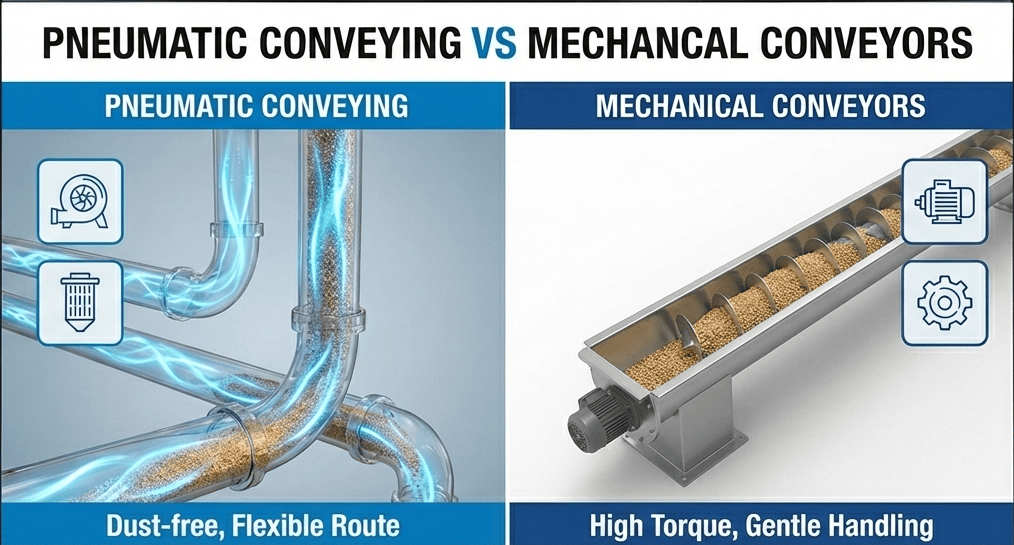
A pneumatic conveying system manufacturer focuses on airflow
dynamics,
pressure control, material behavior, and automation. In contrast, screw conveyor
manufacturers
primarily focus on mechanical design aspects such as screw flights, shafts, and drives.
For complex powder handling applications, pneumatic conveying
manufacturers
provide scalable, efficient, and safer solutions compared to traditional mechanical
systems.
Pneumatic Conveying vs Screw Conveyors – Comparison Table
| Parameter | Pneumatic Conveying System | Screw Conveyor |
|---|---|---|
| Conveying Method | Air pressure / vacuum | Rotating screw |
| Dust Control | Excellent | Limited |
| Hygiene | Very High | Moderate |
| Layout Flexibility | Vertical & horizontal | Mostly horizontal |
| Conveying Distance | Long (200+ m) | Short |
| Maintenance | Low | High |
| Wear & Tear | Low (dense phase) | High with abrasive |
| Automation | Easy | High with abrasive materials Limited |
| Safety | Very High | Moderate |
When Are Mechanical Conveyors Still Used?
Mechanical conveyors may still be suitable for:
- Very coarse or sticky materials
- Short, straight conveying paths
- Applications with minimal hygiene requirements
However, for most powder and bulk solid applications, pneumatic conveying
offers better long-term value.
Why Choose Stratgem as Your Pneumatic Conveying System Manufacturer?
Stratgem Projects is an experienced pneumatic conveying system manufacturer
delivering custom-engineered solutions for diverse industries.
Key strengths include:
- Lean and dense phase conveying systems
- Advanced powder handling solutions
- Robust components and precision engineering
- End-to-end project support from design to commissioning
Compared to standard solutions offered by screw conveyor, Stratgem is the
leading screw conveyor manufacturer that provides cleaner, safer, and more efficient material
handling systems.
Conclusion
Mechanical conveyors such as screw conveyors continue to serve basic
material handling needs, but modern industries increasingly prefer pneumatic conveying for its
hygiene, safety, flexibility, and automation capabilities.
Selecting the right pneumatic conveying system manufacturer ensures
efficient material transfer, long equipment life, and reliable plant performance making
pneumatic conveying the preferred choice over conventional mechanical conveyors.
Looking to upgrade your material handling system?
Contact Stratgem
Projects for an expert-engineered pneumatic conveying solution tailored to your process.
FAQs: Pneumatic Conveying vs Mechanical Conveyors
A pneumatic conveying system uses air pressure or vacuum to move materials
through pipelines, while mechanical conveyors rely on physical moving parts like
screws, belts, or chains.
Pneumatic conveying is generally better for powders and bulk solids due to dust
control, hygiene, and flexibility.
It offers enclosed, dust-free transport, easier cleaning, and less mechanical
wear.
Yes. They are fully enclosed and reduce contamination risk.
Pneumatic systems need less maintenance due to fewer moving parts.
Yes. Dense phase conveying minimizes wear and breakage.
Short distances, fixed layout, higher wear, and dust issues.
Yes, often beyond 200 meters with fewer transfer points.
Screw conveyors may be cheaper initially, but pneumatic is better long-term.
Food, Pharma, Chemicals, Plastics, Cement, Minerals.
It depends on design; optimized systems are efficient.
Yes, many plants replace them for better cleanliness and automation.
Pneumatic systems are safer with fewer exposed moving parts.
Consider material type, distance, hygiene needs, layout, and maintenance.
Simply state your requirement and solution you are looking for Stratgem will provide a solution that will suit your process needs keeping the product integrity and safe operations.





Plan to Start a Project